★★★★★
Gabriel P., Burlingame Park
An alarm popped after some remodel work. Rather than reading a generic code chart, he checked grille clearance and ventilation, found the toe-kick blocking airflow, and cleared it in place.
 Burlingame Sub-Zero RepairIndependent Sub-Zero appliance repair in Burlingame
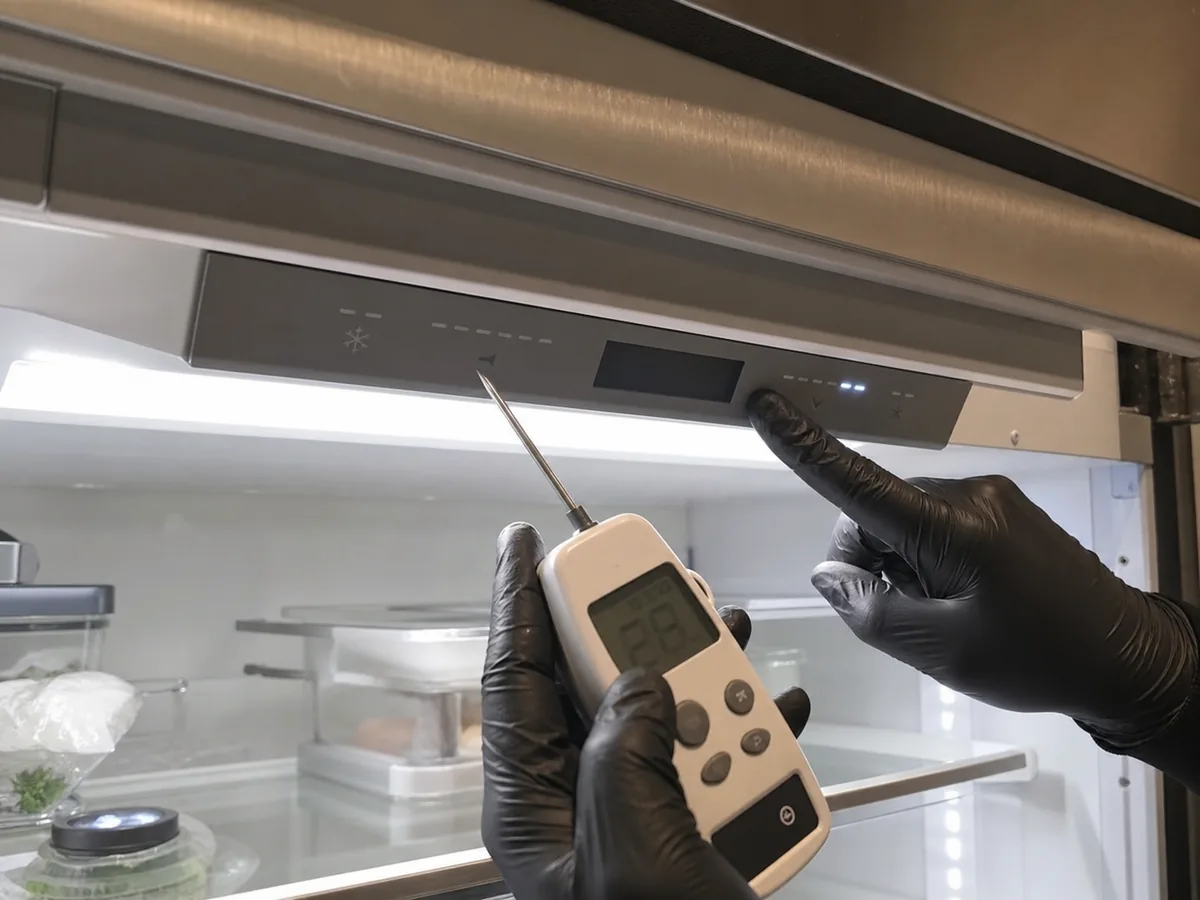
Sub-Zero alarms are read by your exact model and serial, not a generic numeric chart. A flashing "Service" light, a "Vacuum Condenser" reminder, an over-temp or door-ajar alarm and warm fresh-food airflow each mean different things by family. In a fog-prone Burlingame Hills kitchen, photograph the display and note both temperatures before any reset, then call (650) 668-4599.
Visible table
| Alarm / display behavior | What it usually points to | What to do |
|---|---|---|
| Flashing or solid "Service" indicator | A stored fault, sensor or control-board input the unit wants checked | Photograph it, then verify by model and serial before any part is named |
| "Vacuum Condenser" reminder or long run cycles | A packed or dusty condenser, common after a foggy, marine-air week in Burlingame Hills | Pull the grille, clean the coil, then re-probe temperatures over a full cycle |
| Over-temp alarm after a door was left open | Normal recovery, or a marginal sensor if it will not clear | Let it run a full cycle, then re-check; capture the timeline if it returns |
| Fresh-food side warm while the freezer holds | Evaporator fan, iced coil or a stuck air damper, not always the compressor | Record both temperatures and book a model-matched airflow diagnosis |
| Door-ajar alarm or frost building at the seal | A gasket or seal drawing humid Peninsula air past the door | Run a paper-drag test along the gasket and note where it slips |
| Blank, frozen or newer EC-style display message | Board, connector or supply issue; EC wording varies by model | Do not guess a code number — verify the message by model and serial |
These are clues, not a universal numeric chart. Sub-Zero reads each message by the exact model and serial; physical tests still decide the repair.
When an alarm is really a symptom, start with the matching hub: an over-temp or warm fresh-food reading points to not cooling or a freezer running warm; an ice or water alarm points to the ice maker and water line hub; and a drain or water warning points to water leaking from the unit.
Review trust
The wider appliance repair service network is backed by 700+ customer reviews across platforms with a 4.9 average rating. Burlingame customers most often mention careful cabinet protection, clear diagnosis, temperature recovery and estimate clarity.
Burlingame Sub-Zero Repair, 840 Hinckley Road, Burlingame, CA 94010. Phone: (650) 668-4599.
An alarm popped after some remodel work. Rather than reading a generic code chart, he checked grille clearance and ventilation, found the toe-kick blocking airflow, and cleared it in place.
He photographed the alarm and the temperatures before resetting anything, so the timing evidence was preserved. The cause was a defrost sensor, fixed with an OEM part.
Explained that Sub-Zero alarms are clues, not universal codes. He traced ours to a fan fault on the freezer side and proved it before quoting. The alarm has not returned.
Visible table
| Alarm timing | Possible path | First useful evidence |
|---|---|---|
| After door left open | temperature recovery or gasket | temperatures and door contact |
| After power event | control restart or true warming | timeline and display photo |
| After humid week | gasket or condensation | frost or moisture photo |
| Immediately after reset | sensor, control or true fault | model and alarm text |
| With both sections warm | cooling system or airflow | temperatures and grille condition |
A code is a clue; model-specific verification and physical tests still matter.
Alarm hub
A code can point toward a system, but it does not prove a failed part. One model may use a message differently from another. A temperature alarm can be caused by a door leak, fan, blocked condenser, control input or sealed-system issue. Replacing the part named in a chart can miss the real cause.
Timing matters. An alarm after stocking groceries, after a door was left open, after a power event or after a fog-heavy week points to different first checks. A message that returns immediately after reset is different from one returning after a long run cycle.
Alarm hub
Have ready the alarm text or photo, model and serial number, current temperatures, last filter or maintenance date and any recent event such as power outage, heavy loading, door left open or cabinet work. In Burlingame homes, recent remodel adjustments or panel changes can be as relevant as electronics.
Alarm hub
Do not replace a control board from a universal online chart. Do not clear alarms repeatedly before documenting them. Do not ignore true temperature rise because the display message seems minor. The physical symptom and model-specific behavior decide the next step.
Next step
Call or book online with the model number, serial tag photo, current fresh-food and freezer temperatures, and a quick cabinet photo. Same-day routing is available when the Peninsula route, access and required parts allow.
For replacement parts, the policy is straightforward: factory-authorized Sub-Zero OEM parts are used when required, and the finding is documented before repair.
Burlingame Sub-Zero Repair | 840 Hinckley Road, Burlingame, CA 94010 | (650) 668-4599
Visible FAQ
Photograph the message and record temperatures first if food safety allows. A reset can be useful later, but repeated resets can hide whether the alarm returns immediately, after a defrost cycle or after door openings.
Not automatically. Boards can fail, but alarms can also come from sensors, fans, gaskets, airflow, water issues or sealed-system performance. Board replacement should follow input and output testing.
Have ready the alarm photo, model tag, fresh-food and freezer temperatures, symptom timeline and any recent event. Include cabinet or gasket photos if the alarm follows door, remodel or humidity conditions.
They can be incomplete or model-specific in ways that are not obvious. Use them as a clue only. The exact model, physical symptom and diagnostic tests should decide the repair path.
It is urgent when both compartments are rising, food is warming, water threatens flooring, frost grows quickly or the alarm returns immediately after reset. Move food first if temperatures are unsafe.
Yes. Poor ventilation, door misalignment, gasket leaks and recent cabinet work can create temperature conditions that trigger alarms. Cabinet clues should be checked before an electronic part is blamed.